
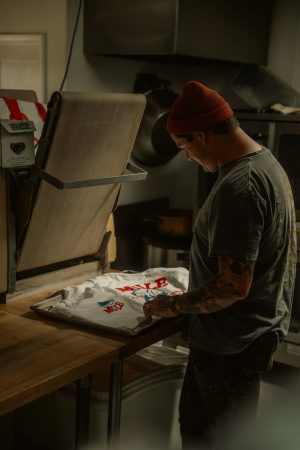
Most teams don’t think about how their colors get onto the fabric until something goes wrong: a crest that cracks after ten washes, a number that peels at the edges, a sponsor logo that fades to grey by August. That’s usually a printing problem, not a fabric problem.
The problem with printing on top of fabric
Screen printing and heat transfer vinyl both sit on top of the fabric. A layer of ink or plastic film is applied to the surface and cured or pressed into place. It looks fine on day one. Then it goes through a wash cycle, a hot dryer, and a season of sliding tackles, and the layer starts to separate from the weave underneath it.
How sublimation actually works
Full sublimation works differently. We print the design onto transfer paper using dye-based ink, then apply heat and pressure that turns the dye into a gas. That gas bonds directly with the polyester fibers of the fabric, not on top of them, inside them. Once it cools, the color is part of the yarn. There’s nothing sitting on the surface to crack, peel, or scratch off.
Where it makes the most sense
This is why sublimation is the standard for anything with edge-to-edge color: full-body kits, gradient designs, sponsor panels that run into seams, patterns that would be impossible to screen print in register. It also means you’re not limited to a handful of Pantone-matched ink colors. If your design has forty shades in it, sublimation prints forty shades at no extra cost per color, unlike screen printing, where every additional color means another screen and another setup charge.
The one limitation to know
Sublimation only works on polyester or polyester-blend fabric with a light base color, because the process needs pale fibers to take the dye accurately. It won’t sublimate onto cotton, and it can’t print white ink onto a dark garment, since the dye adds color rather than removing it. For 100% polyester performance jerseys, which is most of what competitive teams wear, that’s rarely a limitation in practice.
If you’re specifying a kit and aren’t sure which method fits your design, send us the artwork before you commit to a fabric. It’s a five-minute check that saves a reprint later.