
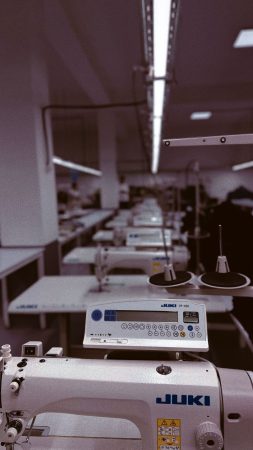
Minimum order quantities exist because setup costs are real: cutting a pattern, threading a sublimation printer, programming an embroidery machine. None of that is free, and a factory has to spread that cost across enough units to make the run worthwhile. That’s also why MOQs vary so much between suppliers. A factory built around 5,000-piece production runs will quote a high minimum because a 50-piece order barely covers setup. A factory built to run small and scale is a different structure.
Why we start at 50 pieces
We start most new clients at a 50-piece trial run. That’s enough to prove fit, colorway, and fabric before anyone commits to a season’s worth of kit, and it’s small enough that a first-time buyer isn’t carrying the financial risk of a bulk order on an unproven design. The trial run uses the same pattern, the same machines, and the same quality checks as a full production order; it’s not a lower-grade sample meant only for approval.
What changes as the order grows
Once a design is approved, scaling up doesn’t mean starting over. The pattern is already cut, the print files are already set, the fabric supplier already has your spec on file. Going from 50 pieces to 500 is mostly a matter of scheduling more machine time and ordering more fabric yardage; the lead time gets longer, but the process doesn’t change. We’ve taken clients from that first trial run to orders above 50,000 units a month on the same production line, without a renegotiation or a re-sample, because the groundwork was done at 50 pieces.
The part that actually gets harder: size runs
Where it gets more complicated is size-run planning at volume. A 50-piece sample might be five sizes, ten pieces each. A 5,000-piece order needs a size breakdown based on actual roster or retail data, and getting that wrong at scale is expensive; you can’t quietly reorder forty medium jerseys the way you can with a small run. We ask for size-run history or team roster data before quoting anything above 1,000 pieces, specifically to avoid that problem.
If you’re evaluating manufacturers and comparing MOQs, ask what happens after the minimum order: whether scaling means a new sample, a new price negotiation, or just a bigger production slot. That answer tells you more about the supplier than the MOQ number itself.